
Why universities should be selling AI as abundance, not anxiety

Young and working-class prospective postgraduate students are considerably more concerned about AI devaluing their skills than any other group.
According to Prospect’s Early Career Survey 2026, and with socio-economic status determined by the occupation of the main household earner, almost 30% of prospective students from a working-class background have AI as their biggest concern.
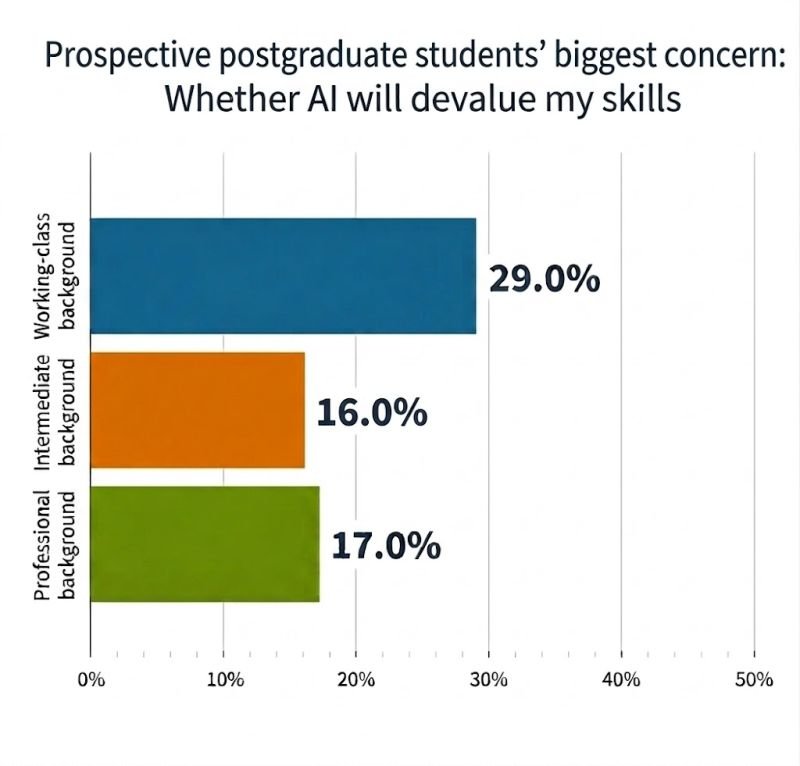
Older prospective postgrads (35+) are the least concerned about AI - just 16% think it will reduce demand for their skills. But for those aged 18-24, almost a quarter have it listed as their biggest concern.
However, I don’t think the “ah ha” is to simply address the concerns of the most affected groups.
Sure, that might help, but the real opportunity is helping students see the potential of AI:
According to LinkedIn’s Work Change report, between July 2024 and July 2025, there was a 60% increase in the number of members who added “Founder” to their profile.
Yeah, it’s easy to add "founder" to your title if you’ve just been laid off. But at the same time, 65% of small business owners agree AI is key to growing their business - that’s a better message, right? Using AI for value creation, rather than protecting skills.
There’s nuance in how professionals can unlock the most value from AI too:
According to research published by Noam Segal, AI Insights Manager at Figma, 70% of tech workers (engineers, designers, founders) - those, apparently, most at risk from the technology - say AI has “improved” the quality of their work.
However, its founders who get the most value. 45% report that the quality of their work is “much better” thanks to AI.
Why?
Most people use AI as an assistant, but founders are different. They mostly use AI for productivity and decision support (32%), product ideation (19%) and company vision and strategy (19%).
AI is a partner.
Founders use it with an abundance mindset, “I can create new value!” rather than scarcity, protecting or optimising existing skills.
That’s a message worth sharing with postgrads (or any student) concerned about the technology.
Of course, this goes way beyond marketing and communication, and is more than a professional development programme that promises “AI skills” - those are a dime a dozen.
Instead, the focus should be:
1) Understanding what employers actually want when they ask for AI skills.
2) Demonstrating to students how to create with AI and turn their best qualities into assets that employers snap up.
3) Shifting the mindset from “I must learn AI skills to stay relevant” to “I can use this technology to make something new, different and previously impossible.”
Ask yourself, are your institution’s promises about AI education one-click deep?
Or are they compelling enough that students don’t see AI as a threat, but as a way of unlocking abundance for their careers
The universities offering a genuine AI education already know the answer.
